


Wurtzite-structured ferroelectric nitrides, such as cation-substituted aluminum nitride, are among the most promising candidates to develop the next generation of energy-efficient nonvolatile memories.
Realizing the full potential of these emerging materials while identifying their limitations for implementing nonvolatile memories requires a comprehensive understanding of the phenomena determining the ferroelectric switching kinetics and their implications on reliability (e.g., endurance and retention). The research at NaMLab focuses on the growth of cation-substituted aluminum nitride thin films, like aluminum scandium nitride, by reactive magnetron sputtering, as well as their structural and electrical characterization targeting specific application scenarios, such as high-temperature operating memories.
Extending the possibilities of growth deposition techniques of wurtzite-structured ferroelectric nitrides is crucial for increasing the number of device technologies in which these materials can be integrated. For instance, good conformality is required for integrating ferroelectrics with fin field effect transistors or in three-dimensional capacitor geometries that enhance memory array densities. With this aim, NaMLab is currently developing atomic-layer-deposition process of cation-substituted aluminium nitride thin films.
Contact

Dr.-Ing. Roberto Guido
E-Mail: info[at]namlab.com



Growth of Wurtzite-Structured Ferroelectric Nitrides. Wurtzite-structured ferroelectric nitride thin films based on the cation-substitution of aluminum nitride (AlN) are grown by reactive magnetron sputtering and atomic-layer deposition. The structural quality of the films is investigated through several techniques, such as X-ray diffraction, electron backscatter diffraction, and atomic force microscopy. The structural properties of the films are correlated with typical ferroelectric properties, such as remanent polarization and coercive field, which are extracted from electrical measurements. The correlation between structural and ferroelectric properties is crucial for optimizing the thin film growth for enhancing the performance of the devices in which these films are integrated.

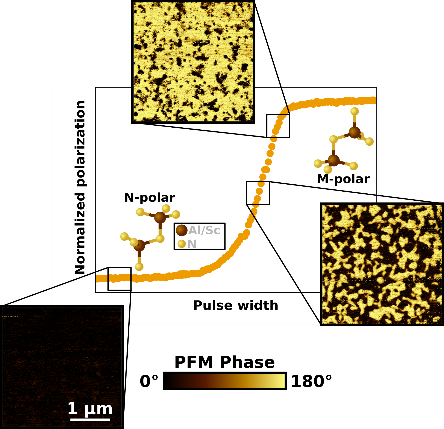
Switching Kinetics. The kinetics of polarization reversal from nitrogen- to metal-polar state and vice versa are investigated through the combination of macroscopic electrical measurements and piezoresponse force microscopy analyses, which are performed in collaboration with project partners. Modeling the ferroelectric switching kinetics is performed to understand the crucial relationship between the applied voltage and the speed at which ferroelectric domain nucleation and domain wall motion occur in these materials.
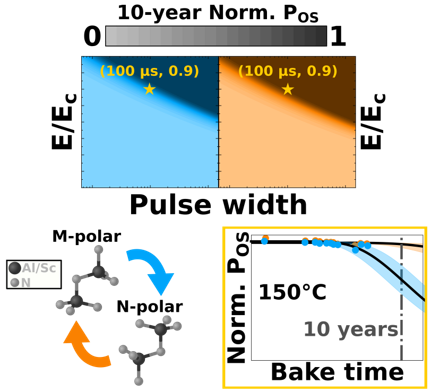
Reliability of the Ferroelectric Properties. The successful integration of wurtzite-structured ferroelectric nitride thin films in devices, such as non-volatile memories or field effect transistors, requires them to be reliable. Typical reliability requirements consist of withstanding repeated switching (i.e., endurance) and/or retaining the ferroelectric polarization, as well as the possibility to reverse it, after a given storage time (i.e., retention). Therefore, reliability testing is routinely performed, and in-house developed models are applied to extrapolate the performance beyond testable conditions.
Running Projects: ExPreFAN, WUMM2.
Closed Projects: WUMM.